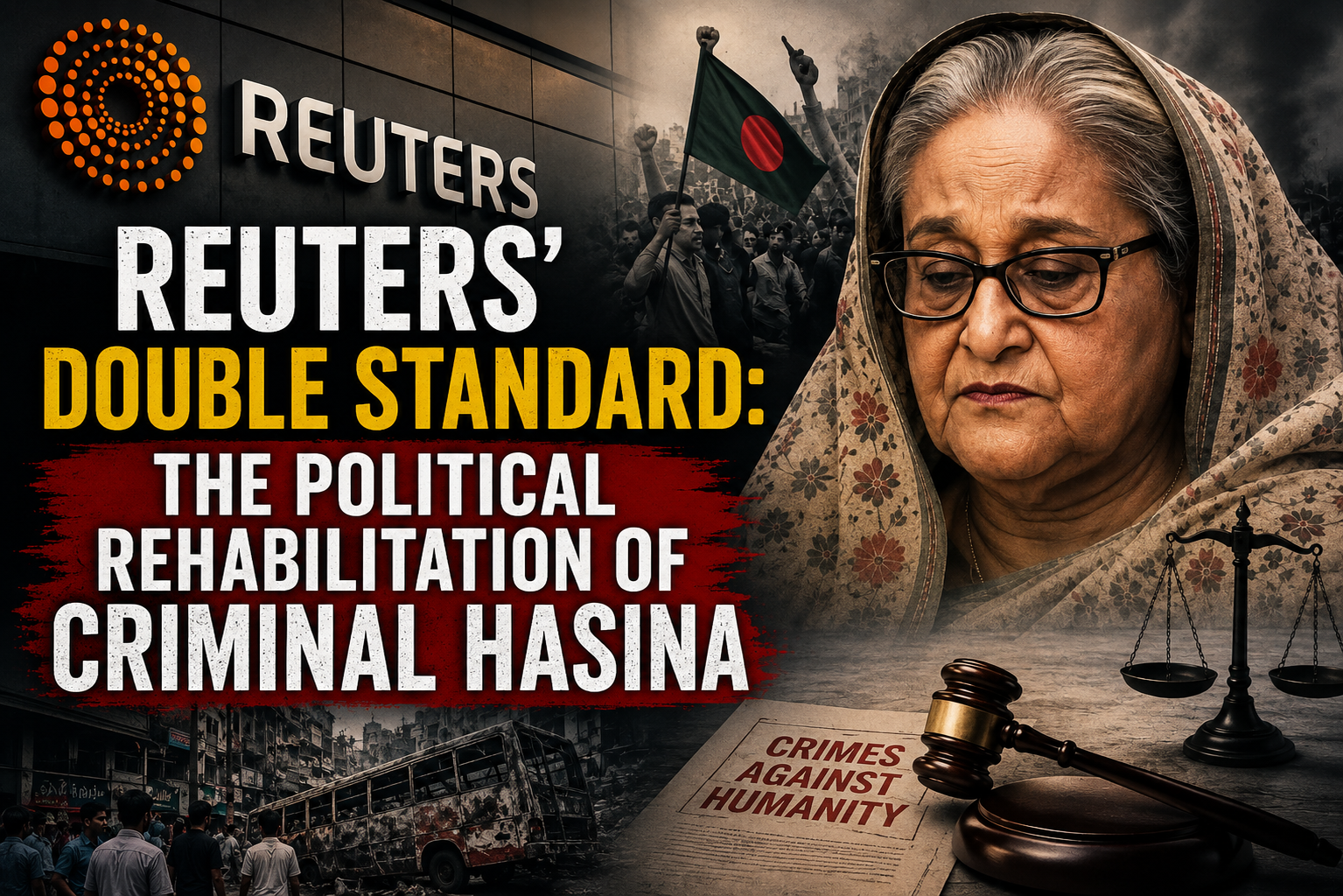
Reuters’ Double Standard: The Political Rehabilitation of Criminal Hasina
Reuters’ Double Standard: The Political Rehabilitation of Criminal Hasina
(This article was written in response to a recent Reuters report. A link to the original report is provided at the end.)
On July 10, 2026, Reuters published a report stating that Sheikh Hasina plans to return to Bangladesh next December and surrender before the court. Built around an interview lasting nearly an hour, the report leaves the impression of a frightened, isolated and persecuted former leader courageously preparing to return home and face justice.
But the reality is far more complicated—and journalism carries a responsibility that cannot be discharged so easily.
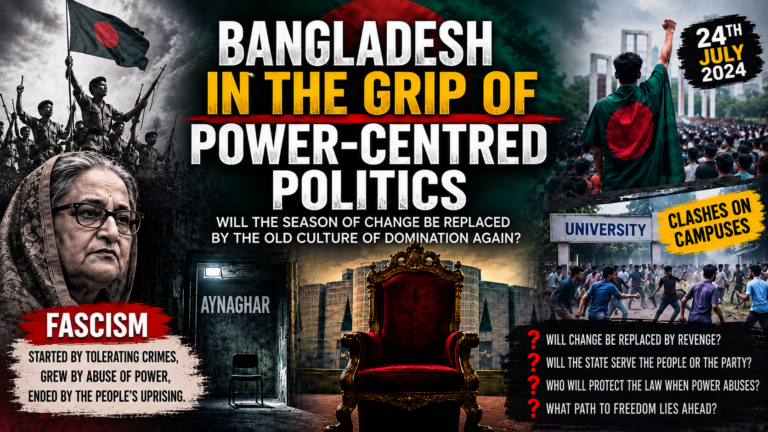
Sheikh Hasina said that when a government remains in power for a long time, some “mistakes” are inevitable. With that single word, she appears to reduce what a United Nations investigation documented as the deaths of around 1,400 people, thousands more injured, widespread arbitrary arrests and allegations of torture.
These are not administrative mistakes. They are allegations that state forces were used against unarmed citizens—acts that, if proven, constitute crimes.
A mistake and a crime are not the same thing.
A mistake may call for an apology. A crime requires justice.
Powerful figures have often relied on this linguistic strategy. The killing of Jamal Khashoggi was also, at one stage, portrayed in softened terms as a “mistake,” even though a U.S. intelligence assessment later concluded that the operation had been approved at the highest level.
The political habit of wrapping serious wrongdoing in gentle language is therefore nothing new. The question here is why a globally respected news organization such as Reuters allowed this framing to reach an international audience with so little challenge.
Think of the young man who lost his eyesight after being shot.
Think of the mother sitting beside the body of her child.
Think of the families of the disappeared who still look toward the door, waiting for someone who may never return.
Can their suffering ever simply be forgiven as a “mistake”?
Sheikh Hasina has described Bangladesh’s judicial process as a “sham.” But the International Crimes Tribunal is a domestic court established under Bangladeshi law—not a secret tribunal, nor a foreign court.
In the case against her, a three-member judicial panel issued a 453-page judgment. The prosecution presented 54 witnesses, including victims, relatives of those killed and expert witnesses. Because Sheikh Hasina was absent, the court appointed a state-funded lawyer to represent her, and that lawyer cross-examined prosecution witnesses.
This was not a proceeding without evidence.
Yes, human rights organizations have raised concerns about trials in absentia and the use of the death penalty. Those concerns should not be dismissed. Bangladesh should strengthen its judicial process so that it meets the highest international standards.
But acknowledging deficiencies is very different from declaring the entire judicial process fraudulent.
And if Sheikh Hasina genuinely believes in justice, why not return from Delhi, stand before the court and challenge the evidence directly?
Sheikh Hasina has also said that the people should decide through elections whether her government was good or bad.
There is a deep irony in that argument.
For more than a decade, her government suppressed opposition parties, constrained the media and presided over successive disputed elections that deprived citizens of meaningful electoral choice. Now she invokes the very “verdict of the people” that her own system was accused of undermining.
The voting rights that were weakened under her rule are now being presented as her shield.
But criminal responsibility cannot be erased through electoral popularity.
Whether someone ordered unlawful killings is determined through evidence, testimony and due process—not through a ballot box.
Reuters devoted considerable attention to Sheikh Hasina’s fear, her desire to die near the graves of her parents, and the suffering of members of her party.
But where were the voices of the parents of students who were killed?
Where was the suffering of young people left permanently disabled?
Where were the children still waiting for relatives who disappeared?
Within the report, Sheikh Hasina emerges as a human figure—afraid, vulnerable and tragic—while those who died under her rule are reduced largely to numbers.
This is one of journalism’s most dangerous forms of imbalance.
Bias does not always take the form of telling an outright lie. Sometimes it lies in deciding whose suffering is given a human face and whose death is compressed into a statistic.
Another serious question was largely left unexplored.
Sheikh Hasina, convicted of crimes against humanity and subject to a formal extradition request, has acknowledged that from Indian territory she has been meeting leaders from 125 of Bangladesh’s 300 parliamentary constituencies in an effort to reorganize her party.
Is India genuinely unaware of these activities?
Given that an extradition treaty exists between the two countries, why has there been such prolonged silence?
And when the report suggests that her return could improve Bangladesh–India relations, another question follows: should relations between two neighboring states really depend on the political future of one convicted former leader?
Justice is not revenge.
If Sheikh Hasina returns to Bangladesh, her personal security must be protected. She must have access to legal counsel and the right to appeal. Nor should ordinary Awami League supporters be treated as criminals merely because of their political affiliation.
But a fair trial and political rehabilitation are not the same thing.
A convicted individual has legal rights. But no one has an automatic right to sit safely abroad, reinvent herself as a persecuted democratic leader, and seek a return to power without first answering the charges against her.
Humanity does not mean worrying only about the safety of a former ruler.
Humanity requires standing with equal concern beside the mother who still cries at her child’s grave.
It means standing beside the young man who lost his eyesight and must now live in darkness.
It means standing beside families who still do not know where their loved ones are.
If Sheikh Hasina wishes to return to Bangladesh, she may return.
But she should not return as a martyr, nor as India’s preferred political alternative.
She should return as a former head of government who must answer, before the law, for documented and adjudicated allegations of serious crimes.
Mistakes can be corrected.
Crimes must be judged.
And the history written in the blood of thousands cannot be erased with softer words.
Bangladesh is not anyone’s political backyard. The history of this country cannot be rewritten through a telephone interview given from Delhi.
Original Reuters report: