Mysteries of the Universe’s Infancy
Neither a Star, Nor a Black Hole as We Know It
The Mysterious ‘Black Hole Star’ Found in the Early Universe
James Webb Space Telescope’s new discovery — explained in simple language
🔭 At a Glance
| Object | MoM-BH*-1, nicknamed the “Black Hole Star” |
|---|---|
| When its light began its journey | Only about 660 million years after the birth of the universe |
| What we are seeing | An image from more than 13 billion years ago |
| Mass of the central black hole | About 100,000 times the mass of the Sun |
| Telescope | James Webb Space Telescope (JWST) |
| Instrument | NIRSpec, an instrument that analyzes light |
| Publication | Nature, peer-reviewed research (2026) |
The farther we look into the universe, the farther back in time we are actually seeing. That is because light from extremely distant objects can take billions of years to reach us.
While looking deep into that ancient universe, the James Webb Space Telescope (JWST) has detected a mysterious object that does not quite fit our conventional picture of a star—but neither does it look exactly like the black holes we are familiar with.
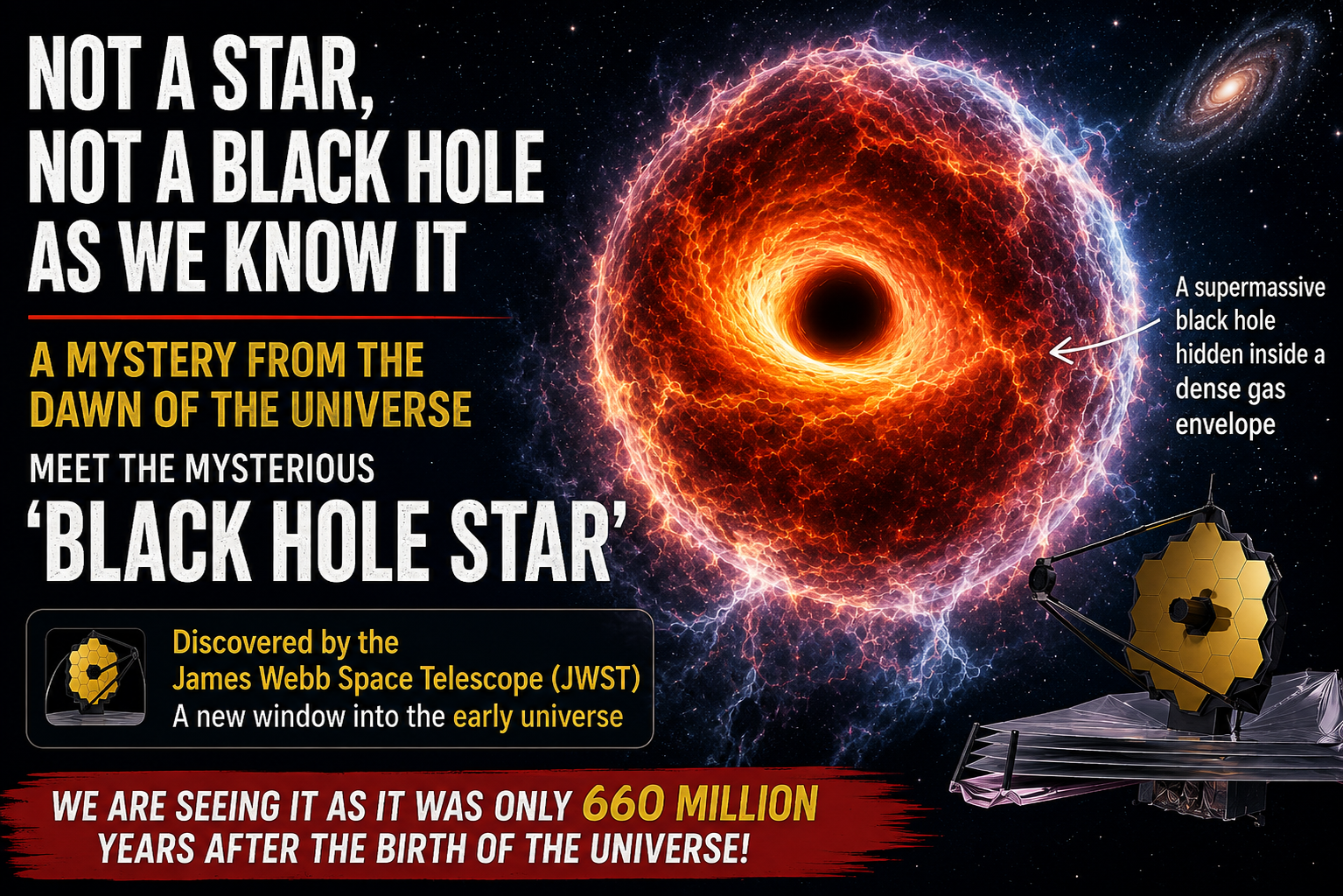
Researchers have named the object MoM-BH-1*. To describe it more simply, they are calling it a “Black Hole Star.”
The most astonishing thing about it is its age.
The light we are receiving from this object began its journey when the universe was only about 660 million years old. In other words, what we are seeing today is a picture of the universe from more than 13 billion years ago.
The Black Holes We Already Knew
Black holes are nothing new to astronomy.
Scientists believe that our own galaxy, the Milky Way, contains numerous black holes. When a massive star reaches the end of its life and collapses under its own gravity, it can form a relatively small stellar black hole.
At the centres of almost all large galaxies, however, we find enormous supermassive black holes.
At the centre of our Milky Way lies a black hole called Sagittarius A*, with a mass about four million times greater than that of the Sun. It is located approximately 26,000 light-years from Earth.
Similar giant black holes have also been observed at the centres of much more distant galaxies.
So the existence of black holes itself is not the new discovery.
Then What Is New About This Object?
MoM-BH*-1 is not merely extremely far away in space. It also takes us enormously far back into the history of the universe.
Its light has taken more than 13 billion years to reach Earth.
That means we are not seeing this object as it exists today. We are seeing what it looked like when the universe was only about 660 million years old.
Put simply, Sagittarius A* in the Milky Way is a familiar supermassive black hole in our cosmic neighbourhood.
MoM-BH*-1, by contrast, belongs to the infancy of the universe. It is almost as though JWST has brought us a photograph taken more than 13 billion years ago.
But Distance Is Not the Only Thing That Makes It Unusual
Around a conventional active black hole, gas and dust can orbit and spiral inward. As that material falls toward the black hole, it becomes extremely hot and releases enormous amounts of energy and light.
The proposed structure of MoM-BH*-1 appears somewhat different.
According to the researchers’ interpretation, a black hole sits at its centre, but it is buried inside an extraordinarily dense and massive envelope of gas.
That envelope may cause the entire system to behave somewhat like a gigantic star.
For this reason, researchers have used the descriptive term “Black Hole Star.”
This does not mean that someone has simply placed a black hole inside an ordinary star.
Rather, the idea is that a black hole lies at the centre, surrounded by an unusually dense and enormous envelope of gas. Together they form a strange type of cosmic object.
| Familiar Active Black Hole | Black Hole Star (MoM-BH-1)* |
|---|---|
| Gas and dust spiral inward, becoming hot and producing intense radiation | A black hole sits at the centre but is buried within an extremely dense and massive gas envelope |
| The black hole is indirectly “seen” through radiation produced around it | The whole system may behave somewhat like an enormous star |
| Commonly observed in the later universe | Seen in the universe’s infancy, only about 660 million years after the Big Bang |
💡 A Simple Analogy
Think of a familiar active black hole as a deep drain with water swirling around it before falling inward—the water is not part of the drain itself, but moves around it.
The proposed Black Hole Star is more like imagining that same drain buried deep inside an enormous, dense sphere of water.
The analogy is not a scientific model, but it helps illustrate the basic difference.
How Large Is It?
According to researchers’ estimates, the black hole at the centre may have a mass roughly 100,000 times that of the Sun.
The gas envelope surrounding it is also enormous.
At the centre lies a massive black hole, while dense gas around it is pulled inward by the black hole’s gravity. As the gas falls inward, it becomes extremely hot and releases tremendous amounts of energy.
What Did James Webb Actually See?
JWST did more than simply take an image of the object.
Scientists used its NIRSpec instrument to analyze the light reaching us from MoM-BH*-1.
By studying light, astronomers can learn an extraordinary amount about distant objects.
It is somewhat like using a blood test to understand what is happening inside the human body. In a similar way, information about a cosmic object is encoded in the light it emits.
The characteristics of the light from MoM-BH*-1 suggest that ordinary stars alone cannot easily explain its enormous energy output and other observed features.
Instead, the observations appear more consistent with the idea of a rapidly growing massive black hole hidden inside extremely dense gas.
Why Are Scientists So Excited?
Because we are seeing this object at a time when the universe was only around 660 million years old.
The central mystery is simple:
How could such a large black hole have formed so quickly?
Finding a massive black hole in today’s universe is not particularly surprising. Such objects have had billions of years to grow.
But finding a large black hole in the very early universe is almost like seeing a baby only a few months old already grown to the size of an adult.
Naturally, the question becomes:
How did it grow so fast?
How Could Such a Massive Black Hole Form So Early?
The universe is approximately 13.8 billion years old.
A small black hole can gradually grow by consuming surrounding matter, but that process requires time.
Yet JWST is now revealing massive black holes in the ancient universe that appear to have become very large much earlier than scientists had expected.
One possibility is that some of the earliest black holes did not begin as small remnants of dead stars and then slowly grow.
Instead, under extremely dense conditions in the early universe, enormous concentrations of gas may have collapsed in such a way that comparatively massive black holes formed from the beginning and then grew very rapidly.
A Black Hole Star could represent one stage in that process.
But this remains a scientific interpretation and hypothesis—not yet a final, proven fact.
Could It Be Connected to the Mysterious ‘Little Red Dots’?
While observing the early universe, JWST has discovered numerous tiny red points of light that astronomers call Little Red Dots.
Scientists are still trying to determine exactly what they are.
Are they extremely compact ancient galaxies?
Dense collections of stars hidden by dust?
Or rapidly growing black holes?
If objects such as MoM-BH*-1 really are massive black holes buried inside dense gas, they could provide an explanation for at least some of these mysterious Little Red Dots.
Where We Need to Be Careful About This Discovery
Scientists have not announced the discovery of an entirely new formal category of star that will now officially be known as a “Black Hole Star.”
That would be an overstatement.
MoM-BH*-1 and its unusual light characteristics have been observed with JWST, and the research has been published in the peer-reviewed journal Nature.
However, the proposed explanation for what the object actually is—a massive black hole surrounded by an extraordinarily dense envelope of gas—still needs to be tested through additional observations and research.
We may be looking at an ancient and unusual stage in the life of black holes—one that could help explain how the enormous black holes found at the centres of today’s galaxies began their journey.
A small amount of light that has travelled across the universe for more than 13 billion years has therefore brought us back to an old question in a new form:
How could such gigantic black holes have formed so quickly during the infancy of the universe?
📖 Glossary: Difficult Terms in Simple Language
| Term | Meaning |
|---|---|
| JWST | James Webb Space Telescope—the most powerful space telescope currently operating, capable of detecting extremely faint light from the early universe |
| NIRSpec | An instrument aboard JWST that separates and analyzes light from distant objects to reveal information about their composition and nature |
| Supermassive black hole | A black hole hundreds of thousands to billions of times more massive than the Sun, typically found at the centres of large galaxies |
| Little Red Dots | Numerous small red objects discovered by JWST in the early universe whose true nature is still under investigation |
| Peer-reviewed | Research evaluated by other expert scientists before publication—an important standard of reliability in scientific research |
Sources and References
1. Nature — “A black hole star at cosmic dawn” (2026)
https://www.nature.com/articles/s41586-026-10846-4
2. MIT News — “Astronomers discover a brand-new type of astrophysical object: the ‘black hole star’” (12 August 2026)
https://news.mit.edu/2026/astronomers-discover-brand-new-type-astrophysical-object-black-hole-star-0812