Where Does the Danger to July’s Future Lie?
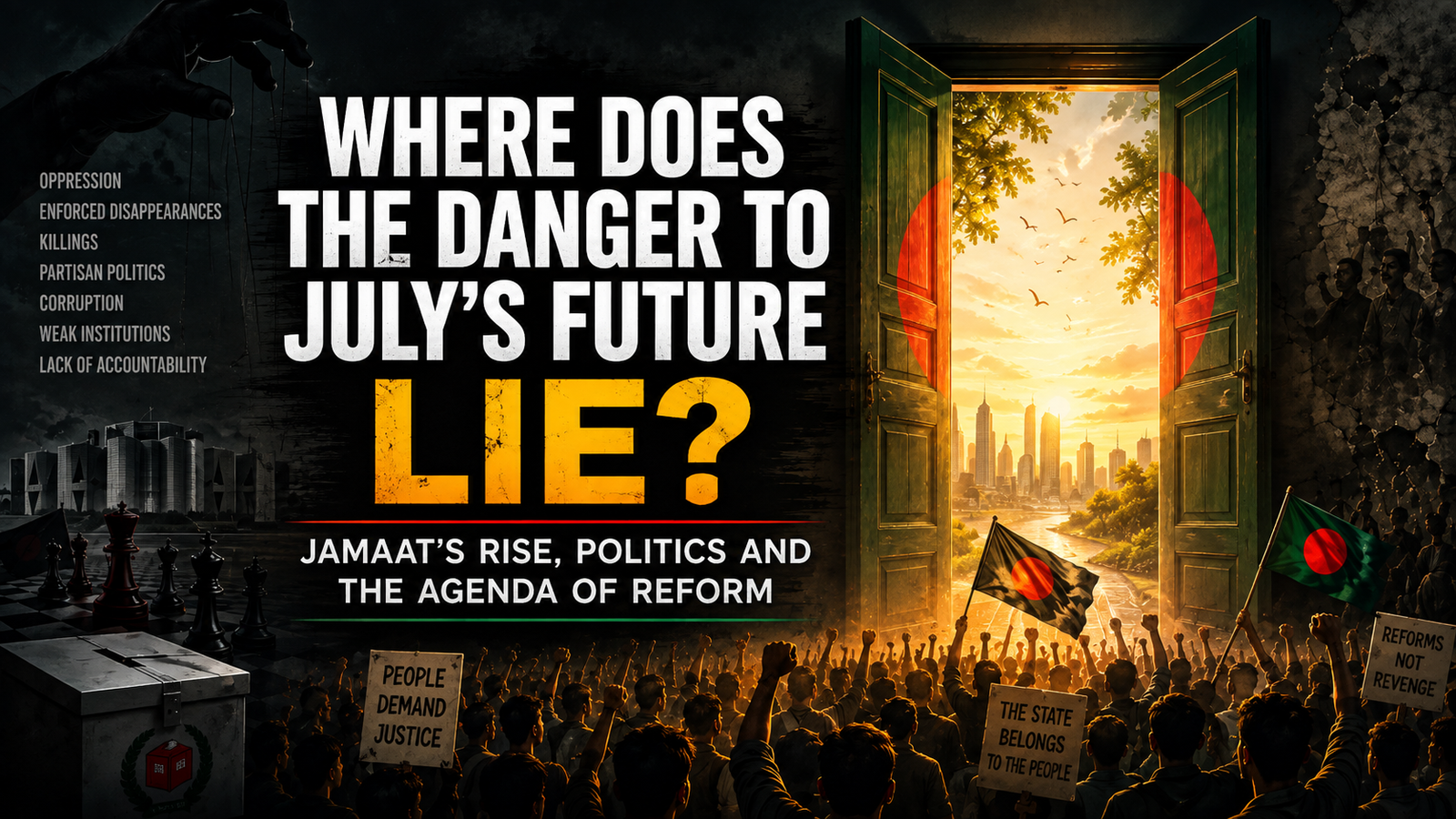
Where Does the Danger to July’s Future Lie?
The July 2024 mass uprising did more than bring down a government. It was an eruption of accumulated public anger against years of repression, enforced disappearances, killings, politicisation, and the absence of accountability. People wanted a state in which no individual or political party could become the owner of the country, institutions would remain independent, and those in power would not stand above accountability.
Two years later, much of that aspiration has still not taken institutional form. But if we see July not merely as the fall of a government, but as the beginning of a longer process of transforming the state, then its most important chapter may still lie ahead.
During July, young people and the wider public displayed a remarkable degree of political awareness and unity. If that experience disappears from our collective memory, the old political culture will find its way back. The real question, therefore, is this: can we keep open the door to change that July opened?
Political Vacuum and the Rise of Jamaat
After the fall of Sheikh Hasina, a significant political vacuum emerged. A section of the younger generation was looking beyond the two traditional parties for a political force that could represent state reform, anti-corruption, and accountability. But no newly organised political force was able to fill that space quickly.
Jamaat-e-Islami, on the other hand, already had a longstanding organisation, an established activist base, and a social network. It is therefore not surprising that a portion of voters seeking change turned toward the party.
In the 2026 election, Jamaat won 68 seats and, according to the Election Commission, received 31.76 percent of the vote—one of the most significant electoral advances in the party’s history.
Reuters had already noticed this shift before the election. Its reporting highlighted Jamaat’s efforts to attract new support through an anti-corruption image, welfare activities, and a comparatively more inclusive political presentation. Jamaat’s rise, therefore, cannot be explained solely in terms of religious sentiment. To do so would ignore an important part of the changing political reality.
Does Jamaat’s Rise Mean Bangladesh Is Moving Toward an Extremist Theocratic State?
Many people may naturally ask this question. The concern arises from Jamaat’s Islamist identity, its role in 1971, and a political narrative built over decades that has continuously presented the party as a marginalised and controversial force.
At the same time, Jamaat’s own ultra-conservative behaviour, political misjudgments, and occasionally unnecessary statements have also given its opponents effective political weapons against it.
But Jamaat’s present political position must also be considered. Its 2026 election manifesto did not contain an explicit commitment to establish a Sharia-based state. Instead, it emphasised issues such as state reform, good governance, social security, and greater participation by women and young people.
For that reason, concluding that Jamaat’s growing strength automatically means Bangladesh is moving toward militancy or theocracy would be an oversimplification. Nor is there any reason to assume that every young person attracted to Jamaat or Islami Chhatra Shibir today supports the anti-independence position of 1971.
1971: An Unresolved Burden
It is a historical fact that Jamaat-e-Islami opposed the independence of Bangladesh in 1971. But more than half a century later, it would also be unjust to impose personal responsibility for that decision on today’s generation of party leaders, activists, or young members of Shibir.
The political decisions of one generation cannot reasonably become an eternal burden upon another. Such an approach is inconsistent with democratic principles.
The problem, however, is that Jamaat has still not clearly enough separated its present political identity from the pro-Pakistan position taken by its leadership in 1971. Whenever the issue arises, the party sometimes becomes defensive and at other times tries to avoid the subject.
Instead, it could state consistently and unequivocally:
“The political position taken in 1971 was the decision of the Pakistan-based leadership of that time. The present generation in independent Bangladesh does not carry that position. Bangladesh is our state, and its independence and sovereignty are beyond question.”
If such a position were stated clearly whenever the opportunity arose, the party would not have to repeatedly explain itself, and its political opponents would have fewer opportunities to exploit the issue emotionally.
Jamaat would not have to abandon its Islamic ideals to do this, nor would it have to become a secular political party. It would simply separate the present organisation clearly from an unresolved political burden of the past.
Carrying that burden while doing politics is rather like running a marathon with a heavy weight on one’s shoulders: it slows the runner down while giving opponents a permanent advantage.
The Meaning of Farhad Mazhar’s Warning
Thinker Farhad Mazhar recently remarked:
“As long as Jamaat exists, Awami League will exist.”
The statement need not be taken literally, but it contains an important political warning.
For decades, one of the Awami League’s most powerful political weapons was 1971: presenting itself as the sole legitimate representative of the Liberation War while confining its opponents within the label of “anti-independence forces.”
July dealt a serious blow to that narrative.
On the streets during July, religious and secular people, left and right, stood together. The central question was not who belonged to which ideology. The question was whether the state would belong to the people or to a single political party.
But the stronger Jamaat becomes while its position on 1971 remains unresolved, the easier it will become for the Awami League to argue:
“The final outcome of July was the strengthening of those who opposed independence.”
That argument does not reflect the whole reality. But in emotion-driven politics, it can still be effective. The reason is simple: 1971 is not merely a historical event; it is deeply connected with sacrifice, national identity, and the birth of Bangladesh itself.
The Real Risk to July
If Bangladesh once again returns to a political divide framed only as “for or against 1971,” then the central questions raised by July will gradually disappear from public debate.
How will state institutions be made independent?
How will enforced disappearances and political repression be prevented?
How will the police, administration, and judiciary be protected from partisan influence?
And how will the country ensure that no political party again gains unlimited control over the state?
If these questions disappear, an old authoritarian force may once again say:
“We may have made mistakes, but we are the force that stands for independence.”
And behind that emotional argument, questions of repression, abuse of power, and the absence of accountability may once again be forgotten.
Therefore, the problem is not that Jamaat is becoming stronger.
The real danger is that Jamaat’s unresolved identity regarding 1971 could one day become a political weapon in the hands of the Awami League—or any other authoritarian force—not only against Jamaat, but against the entire reformist political current that emerged from July.
What Should Be Done?
Jamaat must move beyond a defensive posture on the question of 1971 and state its present position without ambiguity.
Independent Bangladesh is its state. That commitment must be visible not only in statements, but also in its political culture.
At the same time, respect for equal citizenship, political pluralism, and differing opinions must become evident in both its principles and its behaviour. The stronger a political force becomes, the greater the need for restraint.
July did not take place to create a new owner of the state.
Other political forces also have responsibilities. Bangladesh needs the development of a strong democratic and reformist political current that is neither hostile to religion nor willing to turn religion into an exclusive claim to political power.
If the BNP and other political parties fail to occupy that space, another organised force will inevitably do so. Political vacuums rarely remain empty for long.
Final Thoughts
Ultimately, the future of July will not be safe in the hands of any single political party.
It will remain safe only when the people—especially the younger generation—refuse to surrender their independent judgment to any historical narrative.
1971 gave us an independent state.
2024 reminded us that this state does not belong to any individual, family, or political party.
To place these two histories against each other would be disastrous for Bangladesh.
Every political force should therefore be judged by its present conduct:
Does it tolerate dissent?
Does it support independent institutions?
Does it recognise the equal rights of all citizens?
Is it prepared to remain accountable?
July was not the victory of one political party.
It was the commitment of a generation that Bangladesh would never again become the private possession of anyone.
So the question remains the same today:
Will the state belong to everyone—or will it once again become the property of a few?
The responsibility for keeping open the door that July opened belongs to all of us.
Sources
- Reuters, 21 January 2026 — “How an Islamist party is gaining ground in Bangladesh, worrying moderates”
- Bangladesh Sangbad Sangstha (BSS), 15 February 2026 — Election Commission figures on party-wise vote shares
- The Daily Star, 4 February 2026 — Key priorities in Jamaat’s 2026 election manifesto
- Independent TV — Farhad Mazhar’s comment: “As long as Jamaat exists, Awami League will exist.”