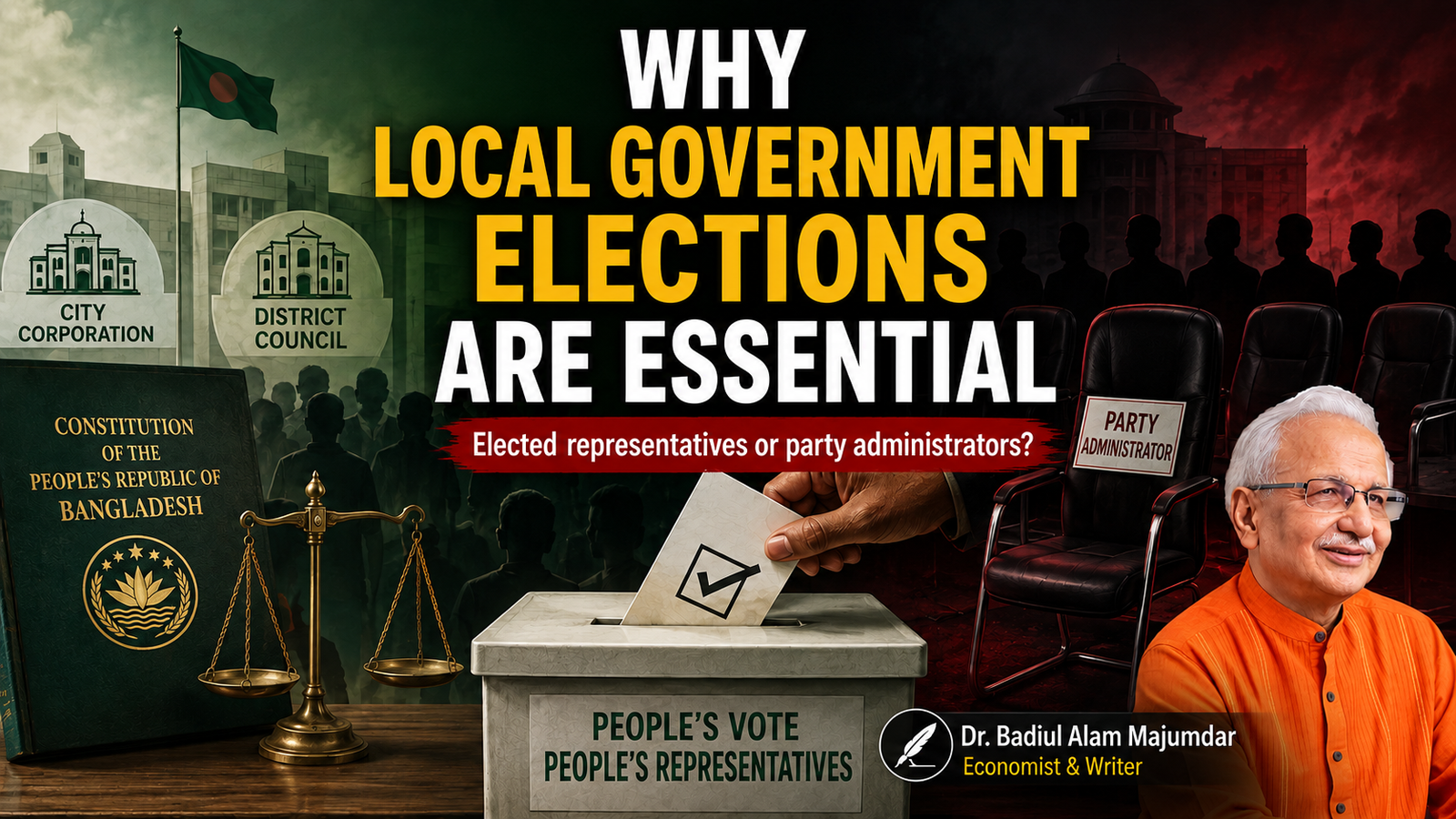
Why Local Government Elections Are Essential
There is both a constitutional obligation and a clear directive from the higher judiciary that our local government institutions must be run through elected representatives. Yet, after assuming office, the newly elected BNP government has appointed party-affiliated administrators to 11 city corporations and 42 district councils. Many of those appointed were either denied party nominations in the 13th parliamentary election or were defeated in the election. This decision to rehabilitate party leaders is directly contrary to both the Constitution and the directives of the courts.
Local government is addressed in Articles 11, 59 and 60 of the Constitution of Bangladesh. Article 11 states that:
“Effective participation by the people through their elected representatives in administration at all levels shall be ensured.”
Article 59 provides that:
“Local government in every administrative unit of the Republic shall be entrusted to bodies composed of persons elected in accordance with law.”
Article 60 further empowers local government institutions to impose taxes, prepare budgets and maintain their own funds.
Article 11 falls under Part II of the Constitution concerning the Fundamental Principles of State Policy. It is therefore not justiciable—that is, the government cannot be compelled through the courts to implement this provision. Article 59, however, is constitutionally binding. Under the existing constitutional framework, therefore, administration at the district level must be carried out by elected district councils, at the upazila level by elected upazila parishads, and at the union level by elected union parishads. Similarly, elected city corporations and municipalities are constitutionally required to administer their respective areas.
It may be recalled that after the abolition of the Upazila Parishad system in 1991, the Appellate Division of the Supreme Court of Bangladesh, in Kudrat-E-Elahi Panir v. Bangladesh [44 DLR (AD) (1992)], under the leadership of Justice Shahabuddin Ahmed, held that local government is an essential component of our democratic system and that its function is to manage local affairs through locally elected representatives. The Court opposed the running of such institutions by government officials or other unelected persons.
The Court stated clearly that if government officials or persons subordinate to them were appointed to run local government bodies, there would be little justification for describing those institutions as local government at all. The fundamental basis of democracy is popular representation.
One of the principal reasons for developing local government as an independent and effective partner of the central government is that, within Bangladesh’s unitary system of government, the Constitution assigns extremely important responsibilities to local government institutions. These responsibilities include overseeing local administration and the activities of public officials, maintaining public order, and preparing and implementing plans relating to public services, welfare programmes and economic development.
To discharge such responsibilities, and particularly the important functions envisaged under Article 59 of the Constitution, there is no substitute for elected representatives who enjoy the confidence of local people and are allowed to perform their responsibilities independently.
By appointing party-affiliated administrators to local government institutions, the ruling BNP has also disregarded its much-discussed 31-Point Outline for Structural Reform of the State. Point 9 states that appointments to state, constitutional and statutory institutions should be made with the objective of restoring transparency, accountability and credibility, rising above narrow political partisanship.
In addition to its opposition to politicisation, Point 21 of the 31-point programme contains an explicit commitment against appointing administrators to local government institutions:
“With the aim of extensive decentralisation of power, local government institutions will be made more independent, stronger and more empowered… Independent local government free from interference by local administration or any other public representative will be ensured. Government administrators will not be appointed to local government institutions unless a position becomes vacant due to death or by order of a court.”
Disregarding such commitments at the very beginning of a new government’s tenure is not an encouraging sign, and this situation should be corrected without delay.
The present reality is that the terms of all local government institutions have expired. Administrators were appointed to some of them during the interim government, and the new government has already appointed party-affiliated individuals as administrators in city corporations and district councils. Yet, in order to comply with the Constitution and judicial directives and ensure that all local government institutions operate under elected representatives, elections at every tier of local government must be held as quickly as possible.
In this regard, guidance may be taken from the Kudrat-E-Elahi Panir judgment. In that case, the Appellate Division allowed a maximum period of six months to replace unelected persons through elections and bring local government institutions into conformity with Article 59 of the Constitution. We believe that this time frame is entirely reasonable and that the present government can take the necessary steps to complete all local government elections within the next six months.
The existing laws governing city corporations and municipalities are, by and large, workable, and elections under those laws can begin immediately. However, there are serious problems with the laws governing rural local government—the district councils, upazila parishads and union parishads. These laws are outdated and inconsistent with one another.
For example, the District Council Act provides for indirect elections through a very limited electoral college, in a manner reminiscent of the former “Basic Democracies” system. In contrast, the chairpersons of upazila and union parishads are elected directly by the people. The three laws governing rural local government could therefore be consolidated into a single integrated law, as has been done in many states of India.
Such a law was in fact drafted in 2007 by a special committee headed by Dr. Shawkat Ali, of which the author of this article was a member. Although the then caretaker government promulgated the draft law through an ordinance, it was not subsequently approved by the elected Parliament.
During the interim government, the Local Government Reform Commission headed by Dr. Tofail Ahmed further refined the local government laws. We believe these revised laws should now be reviewed by a small group of experts, finalised promptly, and followed by elections without unnecessary delay.
Another reality is that although our Constitution envisages an effective local government system operating alongside the central government, in practice the opposite has happened. Our local government institutions have become subordinate bodies controlled by government officials or other public representatives.
Fortunately, the higher judiciary has declared the position of “District Minister” unconstitutional in Anwar Hossain Manju v. Bangladesh, 16 BLT (HCD) (2008). Therefore, while finalising the relevant laws, it must be ensured—in accordance with the BNP’s own 31-point programme—that local government institutions are genuinely independent and free from outside control.
In conclusion, we hope that the government will quickly refine the necessary laws and arrange elections to all local government institutions. At the same time, these institutions must be made genuinely independent and free from political or administrative interference.
The BNP should also demonstrate respect for its own 31-point reform programme, as well as for its election manifesto, which pledged:
“From local government to the National Parliament, the power of the people in the state and government will be established through the direct election of representatives by the people at every level.”
Dr. Badiul Alam Majumdar
Chief Executive, SHUJAN—Citizens for Good Governance
Previously published as a column in Prothom Alo.