Foreign Employment free from Brokers and Exploitation
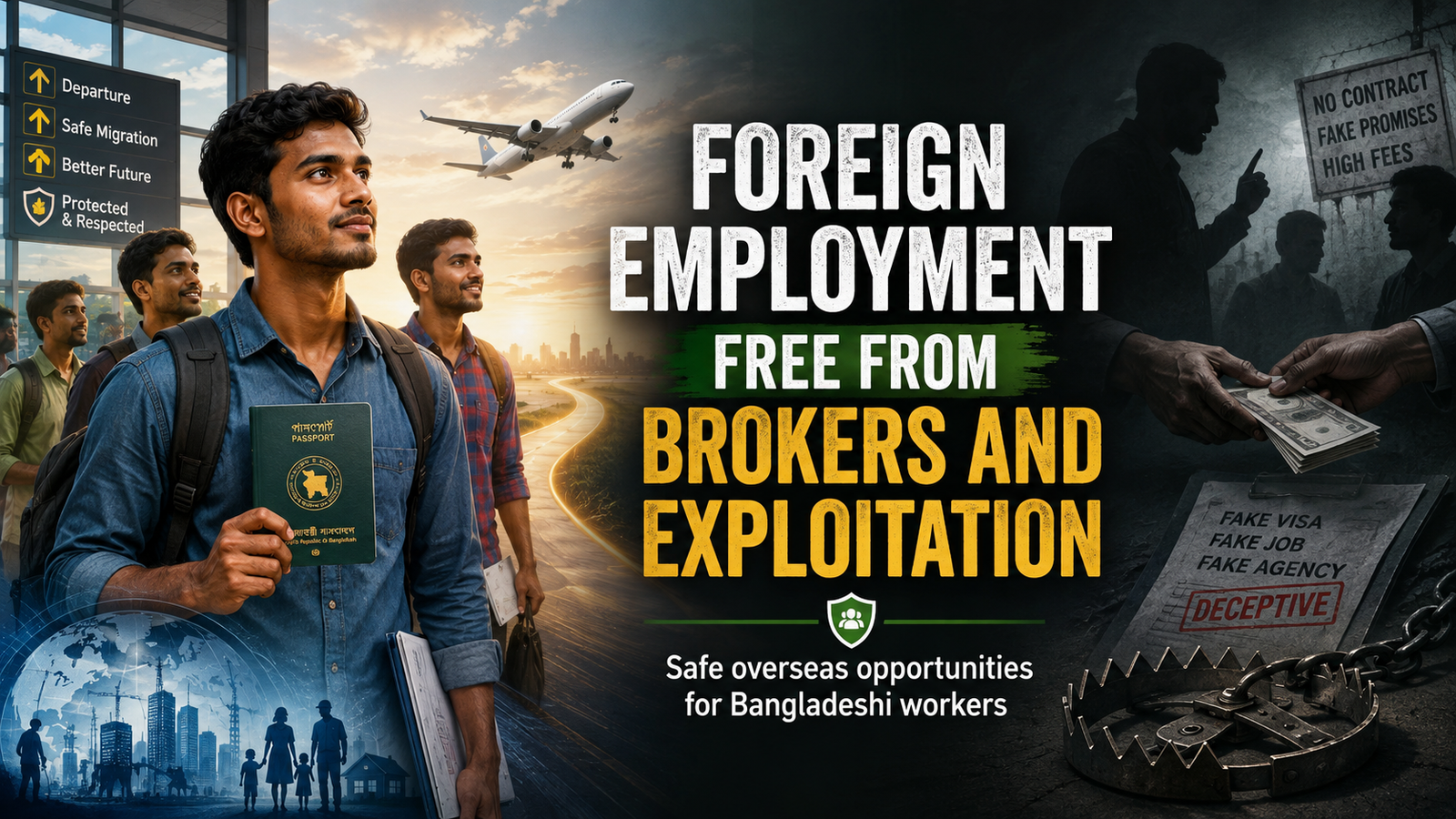
Foreign Employment Free from Brokers and Exploitation
Why is it still so difficult for ordinary people in Bangladesh to find safe overseas employment without falling into the hands of brokers and unscrupulous manpower middlemen? This is a question we all need to ask. Government institutions exist—on paper and at the centre—but brokers are present in the field, at the doorstep of poor young people. Unless this gap is closed, migrant workers will continue to suffer exploitation, fraud and discrimination.
Yet these migrant workers are one of the main pillars of Bangladesh’s economy. In the 2024–25 fiscal year, they sent home more than US$30 billion in remittances. Their contribution to foreign-exchange reserves, the rural economy, household income and overall economic stability is enormous. Despite this, the journey toward overseas employment has still not been made safe, accessible and free from brokers. This represents a major failure of the state.
Foreign employment, therefore, should not be viewed merely as a pathway for individuals to change their fortunes. It should be treated as a strategic sector of the national economy.
Bangladesh already has institutions intended to support migrant workers—BMET, BOESL, DEMO offices, Technical Training Centres, the Wage Earners’ Welfare Board and Probashi Kallyan Bank. Digitally, there are initiatives such as the OEP-BMET platform and the Ami Probashi app.
But institutional structures on paper and realities on the ground are not the same thing.
A World Bank assessment has pointed out that several BMET databases are not interconnected, meaning that a comprehensive labour-market information system has not yet been effectively developed. DEMO offices also lack the capacity to reach the enormous population living in remote areas.
A 2024 study by the Centre for Policy Dialogue, or CPD, found that although more than 1.1 million Bangladeshi workers went abroad in 2023, only 15,294 went through the state-owned recruiting agency BOESL—just 1.3 percent of the total.
That one figure alone reveals how limited the reach of the state system remains.
So when Raju from Sylhet, or a poor young man from Kurigram, dreams of working abroad, his first destination is usually not a BMET office. He goes instead to a familiar broker from his own area.
Why?
Because the broker is someone he knows. The broker comes to his house, talks to the family, offers reassurance, explains the paperwork and sometimes even suggests how the money can be arranged.
This familiarity, trust and vulnerability are then exploited for personal gain. The broker may demand excessive fees, make false promises or push the worker into debt.
Simply banning brokers by law will not eliminate them.
The state must become easier to reach, less expensive and more trustworthy than the broker—and it must reach people at their own doorsteps.
Brokers survive because they solve the last-mile problem.
But the price workers pay for that convenience is extraordinarily high. According to the World Bank, the average migration cost for a Bangladeshi worker can approach Tk 400,000, a significant share of which goes to intermediaries.
ITUC surveys have also shown that recruitment in rural areas is often conducted verbally, without receipts or documentary evidence. When fraud occurs, the victim therefore finds it extremely difficult to seek legal remedy.
The damage is not limited to one worker. It affects the worker’s family and, ultimately, the wider rural economy.
The Solution: Seven Priorities
1. Labour Market Development Cells in Embassies
Every Bangladeshi embassy and high commission should establish a dedicated Labour Market Development Cell (LMDC).
Its responsibility should not merely be to receive complaints from migrant workers. It should actively search for new employment markets.
The government should systematically gather information on which sectors are facing labour shortages, what skills are in demand and which companies are willing to recruit workers directly from Bangladesh.
2. One-Stop Support for Foreign Employers
Bangladeshi missions should establish direct relationships with major companies, hospitals, care homes, construction firms, agricultural businesses, hotel groups and industrial employers.
When foreign employers want to visit Bangladesh to recruit workers, they should be offered coordinated support—including airport assistance, interpreters, interview facilities, skill testing, contract verification and government liaison services.
The goal should be to ensure that once a worker has been selected, he or she can complete the legal process and depart for employment within four to six weeks.
3. Performance-Based Incentives
Embassies should be evaluated according to clear indicators:
How many new companies did they approach?
How many verified job opportunities did they secure?
How many Bangladeshi workers obtained safe employment through those initiatives?
Officials who perform well could receive transparent performance-based recognition, incentives or priority in promotion.
However, this must never become a commission-based system or a competition merely to increase numbers. Worker protection, contract transparency and job quality must remain the principal criteria.
4. Upazila-Level Support Centres
There is no need to create another large bureaucracy.
Existing services provided by BMET, DEMO, BOESL, Technical Training Centres and Probashi Kallyan Bank should instead be brought under one umbrella through a Safe Overseas Employment Support Centre in every upazila.
Mobile service camps could also operate at union level on designated days.
5. Full Transparency of Costs and Information
Verified job opportunities should be published in simple Bangla, clearly stating:
the destination country, job description, salary, government fees, agency fees, training costs and medical expenses.
Every authorised cost should be displayed both online and on noticeboards at local support centres.
If local facilitators are necessary, they should be registered and trained under BMET supervision and made fully accountable. Their service fees should be fixed and official receipts made mandatory.
6. Contract Verification and Worker Protection
Every employment contract should be translated into Bangla and clearly explained to the worker before departure.
The support centre should verify the contract and issue a certification confirming that the job and terms have been checked.
Before departure, essential information—including details of the worker’s family, employer, job description, salary and relevant embassy contacts—should be stored in a secure digital record so that assistance can be provided quickly if problems arise overseas.
7. Expand BOESL, Training and Migrant Loans
BOESL must move beyond a headquarters-centred model.
It should expand through district and upazila-level job fairs, virtual interview booths and a verified employer database.
Training at Technical Training Centres must also be directly linked to actual overseas labour demand. These institutions should not remain merely certificate-issuing centres.
Within BMET’s existing structure, a central Labour Skills and Market Information Cell could be established to modernise these training centres.
Using information collected by Labour Market Development Cells at embassies and high commissions, the government should regularly analyse which skills are becoming more valuable in particular countries.
Training curricula, equipment, language instruction and instructor capacity should then be continuously updated according to those needs.
Training, certification and recruitment should also be connected through a single digital platform.
At the same time, low-interest loans from Probashi Kallyan Bank should be made directly accessible through Safe Overseas Employment Support Centres, without workers having to depend on brokers.
Public awareness must also reach people where they actually live.
Information campaigns should extend from announcements after Friday prayers at mosques to union council meetings, parent gatherings at schools and colleges, and information booths in rural markets.
Government websites and Facebook advertisements alone will never be enough.
The state already has institutions and technology. What is missing is the last-mile connection.
If the government can close that gap by making its services simpler, more transparent and more accessible to people at the local level, the power of the broker network will inevitably weaken.
If Bangladesh wants remittances, then the state must also make the journey of its remittance earners safer and easier.
Failing to do so is not merely an administrative failure. It is also a profound moral failure of the state.
We hope the government will take effective action without delay.
Finally, financing should not be considered a major obstacle to implementing the proposed safe overseas employment system.
Bangladeshi migrant workers send home more than US$30 billion in foreign currency every year. If even a very small portion of the economic value generated by this remittance flow is invested in worker protection, skills development, information services, legal assistance, government-led labour-market exploration, identification of overseas vacancies and prevention of broker exploitation, Bangladesh could build an effective national system.
This should not be viewed as an expense.
It is an investment in protecting Bangladesh’s remittance earners—and in strengthening the country’s future remittance flow.
Sources: CPD, World Bank, ITUC.