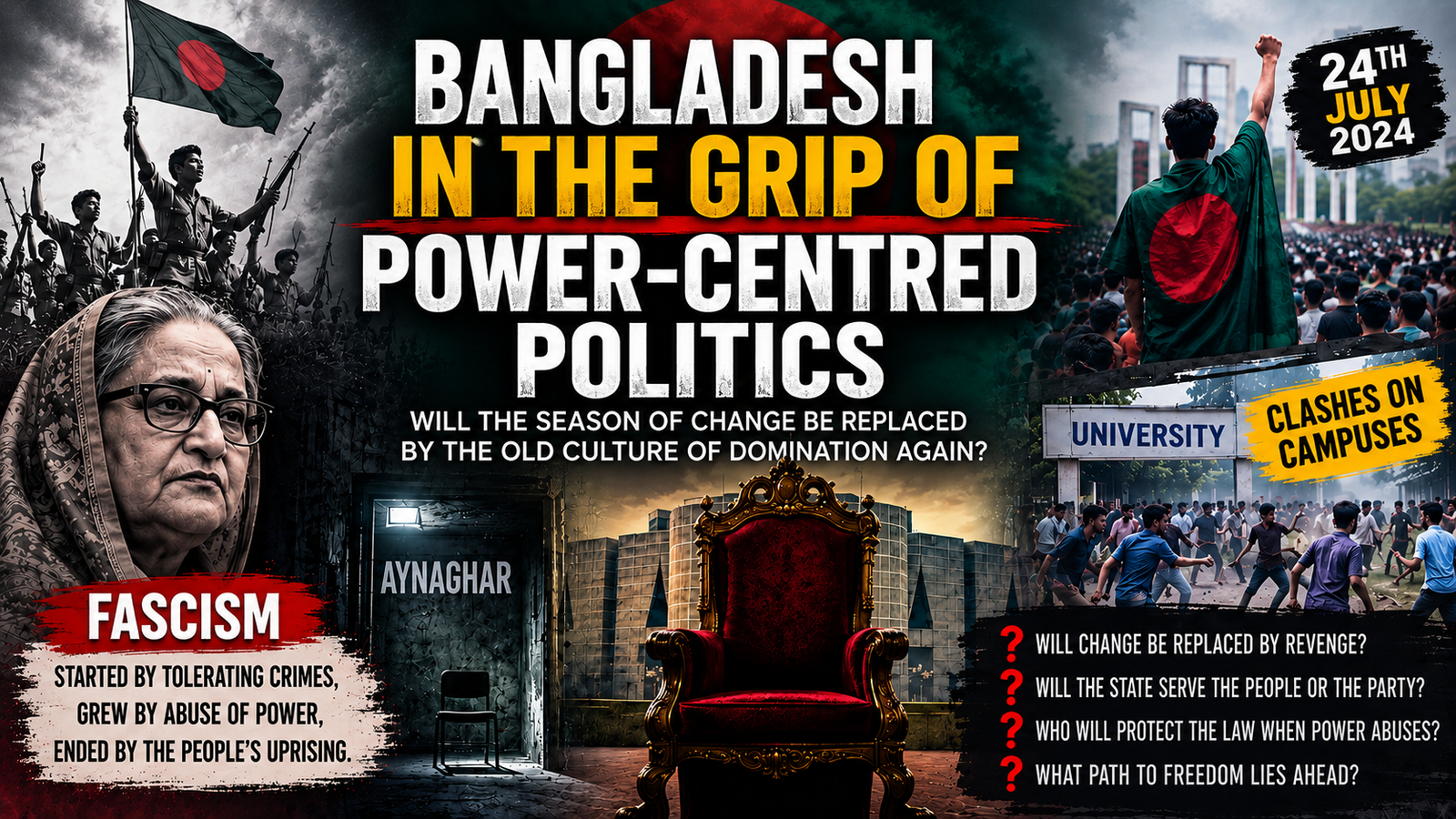
Bangladesh in the Grip of Power-Centred Politics
Bangladesh in the Grip of Power-Centred Politics
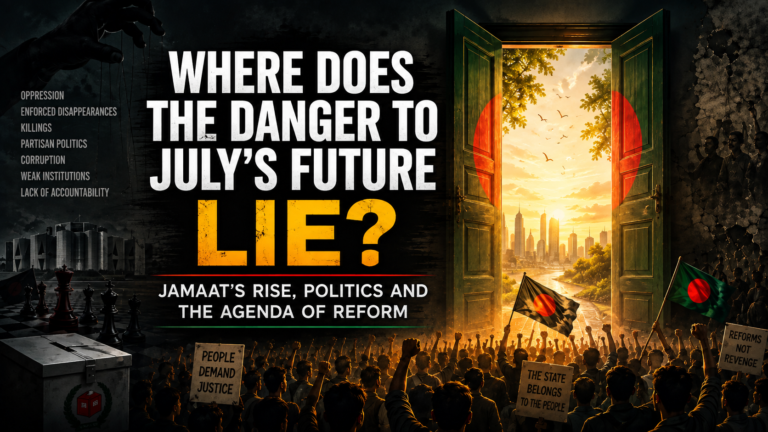
Think about it for a moment. In 1971, we shed blood to free ourselves from Pakistani rule and establish an independent state. In July 2024, people once again took to the streets and shed blood—this time to free that very state from the grip of fascist rule.
Two generations, two different moments in history, yet the aspiration was the same: justice, freedom, and a country where political power does not become a licence for repression.
So the question is unavoidable: after so much blood and sacrifice, why do we keep returning to the same place? Why does a police officer, soon after a change of government, quickly learn not what the law requires—but whose instructions must be obeyed?
This is perhaps our most urgent and uncomfortable political question today. Why does a party that demands a neutral administration, an independent judiciary and free elections while in opposition so often seek to bring those very institutions under its control once it comes to power?
Parties Change, but the Nature of Power Does Not
We often reduce Bangladesh’s political crisis to a struggle between the Awami League and the BNP. But the problem goes much deeper.
In our political culture, elections frequently cease to be merely a competition over who will govern the country. They become a competition over who will control the state.
Coming to power is understood to mean gaining influence over the administration, using the police for political advantage, and placing loyalists in important institutions. This idea has become deeply rooted in our political culture.
As a result, the state gradually ceases to belong to its citizens and begins to resemble the property of the ruling party.
The BNP’s Record Is Not Beyond Question
It would be unfair to history to place this disease entirely at the door of the Awami League.
There have also been allegations during BNP governments that state institutions were influenced for partisan political advantage.
One of the most discussed examples was the 14th Amendment to the Constitution in 2004, under which the retirement age of Supreme Court judges was increased from 65 to 67.
Opposition parties alleged that the amendment would make it possible for then Chief Justice K. M. Hasan to become Chief Adviser of the next caretaker government. Although that allegation was never conclusively established, the political damage was lasting. Public confidence in the neutrality of the caretaker government system was seriously weakened, contributing to the deepening political crisis of 2006.
Then came the government of 1/11.
Whether foreign powers had a role in its emergence, and whether political understandings existed behind the scenes, are questions that have remained part of Bangladesh’s political debate for years. Former Indian President Pranab Mukherjee himself wrote important observations in his memoir about India’s involvement in Bangladesh during that period. These questions therefore cannot simply be dismissed as conspiracy theories.
An election was subsequently held under the military-backed caretaker government and a new party came to power.
Only a few months into that government came the horrifying BDR mutiny. At Pilkhana, scores of army officers were brutally killed. What makes the episode even more disturbing is that it did not take place on some distant battlefield, but in the heart of the capital, inside a secured state compound.
Accounts have repeatedly emerged that trapped army officers appealed to the army leadership and the highest levels of government for help. Yet they could not be saved.
Why the state and the military were unable to intervene in time remains one of the most painful and uncomfortable questions in Bangladesh’s political history.
In an independent country, trained military officers remained trapped for hours in the capital, pleading for their lives while the state failed to rescue them. In many democratic countries, a catastrophe of such magnitude would have triggered a storm over political and moral responsibility, and demands for resignation would hardly have been surprising.
That did not happen here.
Instead, the same political party subsequently manipulated three elections and used state intelligence agencies as instruments of political power, gradually creating an authoritarian, mafia-like and fascist state machinery. Ultimately, its leadership was forced to flee in the face of an uprising led by unarmed students and citizens.
The lesson from this entire period is clear: when state institutions, constitutional provisions and administrative decisions become entangled with partisan interests or domestic and foreign power calculations, the damage does not stop with one government. Public confidence in the entire state structure begins to collapse.
The Fascist Transformation Under Sheikh Hasina
This does not mean that the BNP and the Awami League can simply be placed on the same scale.
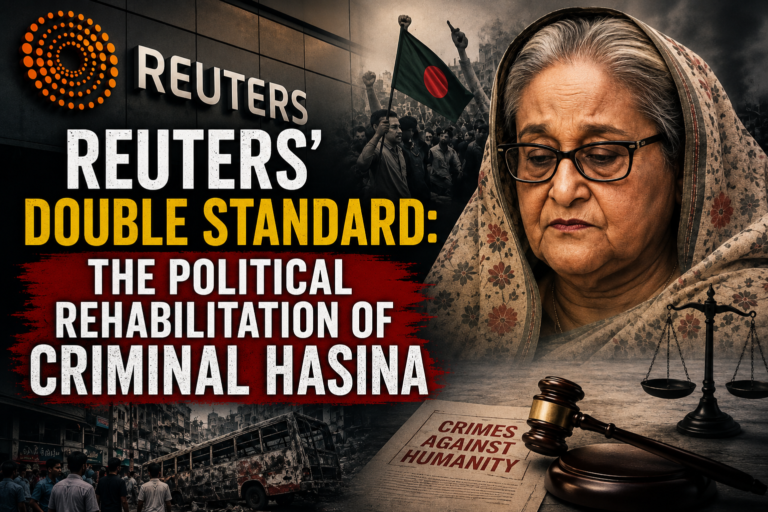
Under Sheikh Hasina, power-centred politics reached a scale and level of brutality that demands separate judgment.
State institutions were brought under partisan control, political opponents were repressed, and meaningful electoral competition was steadily narrowed. The system increasingly assumed a fascist character.
Subsequent investigations have indicated that during her fifteen-and-a-half years in power, enforced disappearance became a systematic instrument of state repression. Nearly two thousand complaints were submitted to the Commission of Inquiry, and more than fifteen hundred cases were found to fall within the definition of enforced disappearance.
Secret detention facilities known as “Aynaghar”, allegations of extrajudicial killings, and so-called “crossfire” also emerged as part of this machinery.
The most terrible expression of the system came during the suppression of the July–August 2024 uprising, which ultimately contributed to the fall of the government.
But the greatest lesson is that fascism does not appear overnight.
It begins in smaller places: intolerance of opponents, protecting party activists when they commit crimes, and teaching the police and administration that political loyalty matters more than professional responsibility.
Is the Present BNP Moving in the Same Direction?
After the fall of the Awami League and its victory in the 2026 election, the BNP had a historic opportunity to demonstrate that Bangladesh’s political culture could be different.
Yet several recent developments have caused concern.
Following an NCP programme in Habiganj on 28 July, the party’s convoy was attacked. The NCP accused local BNP and Chhatra Dal activists, and several people, including Sarjis Alam and Nasiruddin Patwary, were injured.
Responsibility should, of course, be established through investigation. But when allegations involve people associated with the ruling party, the government carries an even greater responsibility to ensure a rapid, credible and visible investigation.
There are also concerns about the legal framework dealing with enforced disappearances.
Human rights organisations have expressed concern that the ordinance introduced during the interim government has not been adequately converted into law under the elected government and that independent investigative powers may be weakened.
A country that has experienced Aynaghar cannot afford to weaken the authority to investigate enforced disappearances.
Is the Old Culture of Domination Returning to Campuses?
Recent months have also seen repeated clashes between Chhatra Dal and Islami Chhatra Shibir at universities and colleges, including several incidents in Dhaka and at the University of Barishal during the first week of August.
These incidents should not be treated lightly.
Bangladesh has already witnessed the consequences of the long-standing culture of violent campus domination associated with the Chhatra League.
If only the name of the student organisation changes while the culture of domination and confrontation survives, one of the fundamental lessons of July will have been lost.
The state should have only one question:
Who broke the law?
Whether the offender belongs to the student organisation of the ruling party or to any other organisation, the same law must apply.
The Islami Bank Controversy and a Remark
Allegations have been raised in Parliament that attempts are being made to restore the influence of individuals associated with S. Alam Group over Islami Bank.
The allegation requires independent verification, but the underlying question goes to the heart of the matter:
Will institutions operate according to rules, or according to the wishes of powerful groups?
In this context, a comment by NCP leader Sarwar Tushar is worth considering:
“The Awami League is a successful BNP, while the BNP is a failed Awami League.”
The statement should not be taken literally, nor should the two parties be treated as identical.
But the question behind it cannot simply be ignored: will the BNP learn from the fall of the Awami League, or will it gradually return to the old culture of power-centred politics?
The concern is not yet the destination. It is the direction of travel.
Servants of the State—or Loyalists of the Party?
Power-centred politics depends upon a culture of administrative loyalty.
A government official is not the personal employee of whichever party happens to be in power. He or she is an employee of the state and a servant of the public.
Promotion within the administration and police should therefore depend on professional competence and impartiality—not submission to a political party.
But another difficult question arises: who will determine whether an official has been partisan?
If investigations into politicisation are themselves conducted by people controlled by the ruling government, the problem will not be solved. Instead, a new door will be opened to political revenge.
Vague labels such as “sycophant” or “party loyalist” cannot be sufficient grounds for punishment.
Disciplinary action must be based on demonstrable conduct. That requires an independent professional disciplinary system protected by law, together with the right to defend oneself and a proper appeals process.
Removing the loyalists of one party only to replace them with the loyalists of another solves nothing.
The real task is to build a state structure in which political sycophancy is no longer necessary for professional survival or advancement.
Do Independent Institutions Reduce a Government’s Power?
One of the deepest misconceptions among our political leaders is that independent institutions weaken the government.
In reality, the opposite is true.
An impartial police force may refuse today to protect a criminal associated with the ruling party. But tomorrow, when that same party is in opposition, the same impartial police force will also be unable to harass its members for political reasons.
An independent court may strike down an unlawful decision of today’s government. But after that government loses power, the same court can protect its former leaders from political revenge.
Independent institutions are therefore not enemies of political parties.
They are a form of political insurance for both those in government and those in opposition.
The greatest beneficiaries, however, are ordinary citizens.
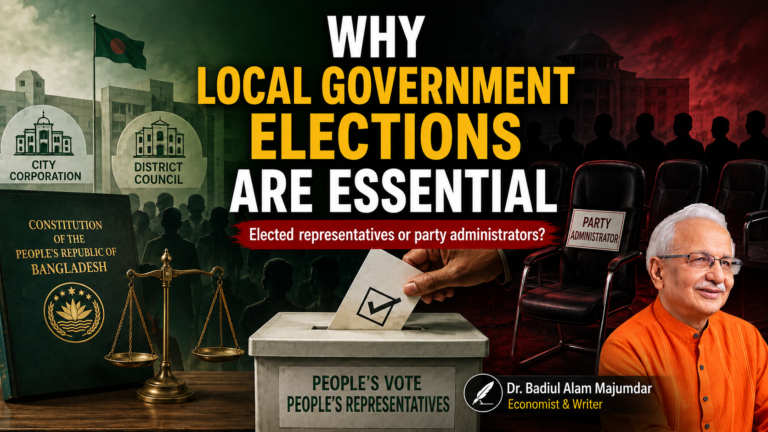
With an impartial police force, an independent judiciary, a professional administration and an autonomous Election Commission, citizens no longer have to search for a political connection in order to receive justice or basic services.
The state then belongs neither to the Awami League, nor the BNP, nor Jamaat, nor the NCP.
The state belongs to its citizens.
Political parties themselves also have a direct interest in such a system because power is never permanent.
If a party turns the police into a political weapon today, that weapon may be placed in someone else’s hands tomorrow.
But if a party helps establish institutions strong enough to restrain even its own abuses while it is in government, those same institutions can protect its rights after it loses power.
Independent institutions are therefore not an act of political self-destruction.
In the long run, they may be the strongest form of political security.
What Must Change Is Not Just the Government, but the Nature of Power
1971 gave us an independent state.
July 2024 demonstrated once again that when repression and injustice cross a certain limit, people will take to the streets—and they may even sacrifice their lives.
But if the political culture governing the state remains unchanged, merely replacing one government with another will eventually bring us back to the same place.
Changing the holder of power does not solve Bangladesh’s fundamental political crisis.
We need a state system in which, regardless of which political party forms the government, the police, administration, courts and Election Commission belong to no party.
They are institutions of the state, and they must operate according to the Constitution and the law.
A ruling party may lose some immediate political advantages under such a system. But in the long run, every political force will benefit—and the greatest beneficiaries will be the people of Bangladesh.
Governments come and governments go.
The state and its institutions remain—if we allow them to remain.
To genuinely honour both the spirit of 1971 and the aspirations of July 2024, changing rulers will not be enough. We must change our understanding of political power itself.
The state must not remain subordinate to political parties.
Political parties must become subordinate to the Constitution, the law and the institutions of the state.
Only then can Bangladesh begin to free itself from the old curse of power-centred politics.
Sources and References
- Banglapedia — Constitutional Amendments
https://en.banglapedia.org/index.php/Constitutional_Amendments - The Daily Star — 2006 caretaker government crisis and K. M. Hasan
https://www.thedailystar.net/2006/10/28/d6102801044.html - Human Rights Watch — Bangladesh: Ensure Justice, Reparation for Victims and Guarantees of Non-Recurrence, 26 May 2026
https://www.hrw.org/news/2026/05/26/bangladesh-ensure-justice-reparation-for-victims-and-guarantees-of-non-recurrence - Human Rights Watch — Commission of Inquiry on Enforced Disappearances and secret detention sites
https://www.hrw.org/news/2025/06/16/bangladesh-extend-the-mandate-of-the-commission-of-inquiry-on-enforced - The Business Standard — NCP July March attacked in Habiganj, 28 July 2026
https://www.tbsnews.net/bangladesh/politics/ncps-july-march-attacked-habiganj-sarjis-nasiruddin-injured-1500481 - Prothom Alo — Student clashes at multiple Dhaka institutions, August 2026
https://www.prothomalo.com/bangladesh/capital/iqo5834t3m - Ittefaq — Allegation concerning the return of S. Alam-linked influence at Islami Bank
https://www.ittefaq.com.bd/792802/ - Ittefaq — Sarwar Tushar’s “successful BNP / failed Awami League” remark, 9 April 2026
https://www.ittefaq.com.bd/783605/