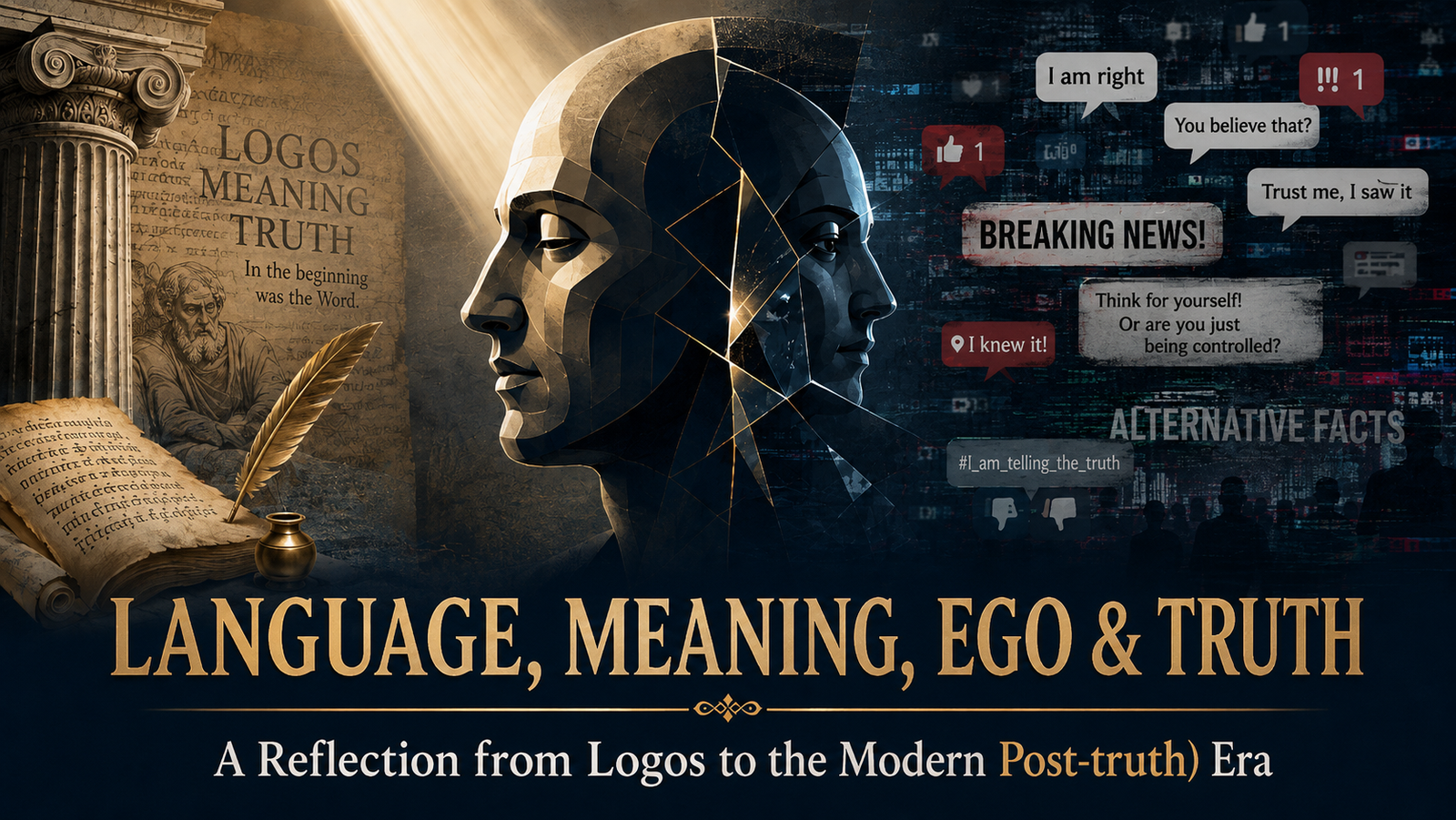
Language, Meaning, Ego and Truth: From Logos to the Modern Post-Truth Era
Language, Meaning, Ego and Truth: From Logos to the Modern Post-Truth Era
Today I had a long and thought-provoking conversation with a friend about language, meaning, and communication. Our discussion touched on linguistics, the Greek concept of Logos, Stoic philosophy, the differences between oral and written communication, and the question of how successfully one person can convey their intended meaning to another through language. From there, our conversation eventually reached the reality of the modern post-truth era, where the relationships among truth, interpretation, belief, identity, and language have become increasingly complex.
In this article, I do not attempt to reproduce the entire discussion. Rather, I have tried to present a brief summary of its central questions and ideas.
Can Language Really Convey What Is in the Human Mind?
Our discussion began with a simple but profound question: when a person speaks, can they fully convey their intended meaning to another person?
At first glance, the answer seems straightforward: I say something, you hear it, and you understand it. But modern linguistics—particularly semantics and pragmatics—does not view communication so simply.
A sentence has a linguistic or semantic meaning: its direct meaning based on words and grammar. But what the speaker actually intends to communicate is often not fully contained in the sentence itself.
Suppose someone says:
“The room is quite cold.”
Are they merely stating a fact? Are they asking someone to close the window? Are they suggesting that the heater be turned on? Or are they perhaps making some other indirect point?
The words remain the same, but the intended meaning depends on context.
Language therefore provides us with a structure for meaning, but it does not transfer the complete contents of one mind directly into another. The listener must interpret. Communication is therefore not simply an exchange of words; it is an interpretive process.
Is Oral Communication Superior to Written Communication?
From there, our discussion moved to the difference between oral communication and written communication.
When a teacher or speaker is physically present, we can ask questions. If something is misunderstood, the speaker can immediately clarify it. Tone of voice, pauses, facial expressions, and gestures also contribute to meaning.
If I misunderstand something in a written text, the author cannot immediately interrupt me and say:
“No, that is not what I meant.”
In direct conversation, however, such clarification is possible. This is one of the great strengths of oral communication.
But an important distinction must be made here. The presence of a teacher may help clarify what the teacher means; it does not prove that what the teacher says is true.
A teacher may explain something very clearly and still be wrong. I may understand the teacher’s intended meaning perfectly, yet what is being said may not correspond with reality.
So two questions must remain separate:
What does the speaker mean? and Is what the speaker says true?
The first is a question of communication. The second is a question of truth.
Language conveys meaning; reason evaluates that meaning; and reality tests the truth.
Logos: A Concept Larger Than a Word
Our discussion then turned to the ancient Greek concept of Logos.
In English, Logos is often translated as “Word,” but its meaning extends far beyond a single word. Its range includes speech, statement, explanation, reason, cause, intelligible order, and rational principle.
In the thought of Heraclitus, although the world is in constant change, there is an intelligible order underlying that change. Later, the Stoic philosophers developed the idea further and spoke of a rational structure or universal reason operating within the cosmos.
Here Logos is no longer merely a spoken word. It becomes a concept in which language, reason, and intelligible reality are interconnected.
A person thinks.
That thought is expressed through language.
Another person interprets the language.
And through that interpretation, attempts to reach the thought behind it.
Thought → Language → Interpretation → Understanding
But understanding is not necessarily truth.
Do We Hear Words, or Do We Construct Meaning?
One important lesson of modern linguistics is that human beings do not merely decode words during communication. We use context, infer the speaker’s intention, rely on shared knowledge, and make inference-based judgments.
Someone may say sarcastically: “Excellent work!”
The literal meaning of the words is praise. Yet from the tone of voice we may understand that the speaker means exactly the opposite.
Meaning, therefore, is not imprisoned inside words. Words provide signals, while meaning emerges through the interaction of speaker, language, context, and listener.
This does not mean, however, that everyone is free to invent any meaning they wish.
Interpretation also has limits. Conventional rules of language, context, evidence, the speaker’s own clarification, and logical consistency all help determine whether a particular interpretation is reasonable.
Human Beings, Ego, and the Limits of Change
Another human reality emerged in our discussion: at the end of the day, human beings continue to live largely within their own sense of self, ego, experience, and psychological formation.
Whether highly educated or uneducated, philosopher or spiritual seeker, completely transcending oneself is not easy.
We often assume that with enough argument, education, or pressure, we can make another person think as we do. In reality, human beings are much more complex.
Each person is a unique combination of experience, temperament, memory, culture, fear, desire, and identity. In that sense, every human being is unique.
People can certainly change. They can learn and correct their mistakes. But another person’s deep character or beliefs cannot simply be reconstructed from the outside according to our wishes.
Indeed, humiliation, coercion, or persecution may strengthen a person’s existing position rather than change it.
This is where the role of ego becomes important.
We like to think of ourselves as seekers of truth. Yet in practice, we often accept information more readily when it protects our prior beliefs, identity, and self-respect. When contrary evidence appears, our first reaction is often not to examine whether it is true, but to defend the position we already hold.
The Post-Truth Era: When Identity Overshadows Truth
From here, our discussion reached the post-truth era.
Post-truth does not mean that truth no longer exists. Rather, it describes a social condition in which emotions, identity, personal beliefs, and repeatedly promoted narratives can influence public opinion more strongly than objective facts.
Post-truth is not an entirely new human tendency. Human beings have always had a tendency to see truth selectively—or ignore it altogether—because of emotion, group identity, prior beliefs, or personal interest.
What is new is its modern scale and influence, particularly because of social media, political polarization, and the extraordinary speed of information flows. It was this altered reality that led Oxford Dictionaries to select “post-truth” as its Word of the Year in 2016.
Sometimes the question “Is this information true?” becomes less important than:
Does it agree with what I already believe?
Does it support my group?
Does it satisfy my emotions?
When that happens, the relationship with evidence weakens and identity begins to take precedence over truth.
Social media has intensified this tendency. If a falsehood is repeated often enough, aligns strongly enough with people’s emotions, and is presented with sufficient confidence, it can begin to feel true to many people.
This is where language itself can become dangerous.
Language does not merely describe reality; it also shapes how people perceive reality.
The same event may be described by one person as a “protest,” by another as “disorder,” and by someone else as a “revolution.”
The event may be the same, but changing the word can change the emotional response.
That is why, in the post-truth era, many struggles are not simply about facts; they are struggles over framing.
How, Then, Do We Reach the Truth?
No teacher, writer, speaker, book, institution, or tradition guarantees truth merely because it possesses authority.
At the same time, our own interpretation is no guarantee of truth either.
What we need, therefore, is a form of intellectual discipline.
First, we should try to understand what the speaker intends to say.
Then we should ask why they are saying it.
After that, we should examine the evidence, consider alternative explanations, and finally compare the claim with reality.
In other words, understanding meaning requires openness, while testing truth requires critical reason.
Humility is also essential. Human beings can mishear, misunderstand, misremember, and selectively choose evidence because of their own biases.
Recognizing these limitations is one of the first conditions of a genuine search for truth.
Conclusion
From the ancient Greek Logos, to modern linguistics, from there to the human ego, and finally to the post-truth era, one common question repeatedly returns throughout this discussion:
What is the relationship between words and truth?
Words help us reach one another. Language allows us to express thought. Dialogue reduces misunderstanding. Written language allows ideas to survive beyond the limits of time.
But no word, by itself, guarantees truth.
To approach truth, we must go beyond words—to reason, evidence, and reality.
And perhaps the greatest obstacle is not always some falsehood outside us, but the ego within us. We often do not want to see truth simply as it is. We want truth to fit comfortably with our beliefs, identity, and sense of self-worth.
The greatest enemy of truth is not always falsehood.
Sometimes the greatest enemy of truth is our own ego—the part of us that tries to establish as truth whatever we already wish to believe.
Conclusion
From the ancient Greek Logos to modern linguistics, from there to the human ego, structured identity, and the post-truth era, one question repeatedly returns throughout this entire discussion:
How simple is the relationship among what we say, what we understand, and what we accept as truth?
Words help us express our thoughts, but they do not always capture the complete meaning within our minds with perfect accuracy. We say something, and later feel that what we really wanted to say has not been fully expressed. So we add something more. But the new explanation gives rise to new questions.
Language, therefore, is often an ongoing and incomplete expression of our intended meaning, rather than its perfect replica.
Human identity is similarly complex.
We like to think of ourselves as completely independent and self-contained individuals, but a large part of our identity is formed through family, society, education, culture, profession, political or social groups, and long experience.
As a result, we do not always respond from some entirely independent “self.” Often our reactions emerge from the structured identity within which we have learned to understand ourselves.
When ego becomes attached to this identity, the situation becomes even more complicated. The ego often begins to defend the identity, beliefs, and positions we have accepted as our own.
Then, when contrary evidence appears, our first instinct may not be to examine the truth, but to defend our existing position.
This is why the post-truth era is not merely a problem of misinformation or false propaganda. It is also a problem of language, identity, group loyalty, emotion, and psychological self-defense.
People often do not see truth simply as it is. They see it through the mental and social structures within which their sense of “self” has been formed.
Therefore, the search for truth cannot be limited to examining the claims of others.
We must also ask ourselves:
Do I believe this because the evidence supports it, or because my identity has taught me to believe it?
Am I rejecting this argument because it is genuinely weak, or because it makes my own established position uncomfortable?
The greatest enemy of truth is not always falsehood. Sometimes the greatest obstacle on the path to truth is the structured “self” that, before accepting truth, first wants to know whether that truth is compatible with its identity, beliefs, and self-respect.