World Cup Craze and Some Reflections
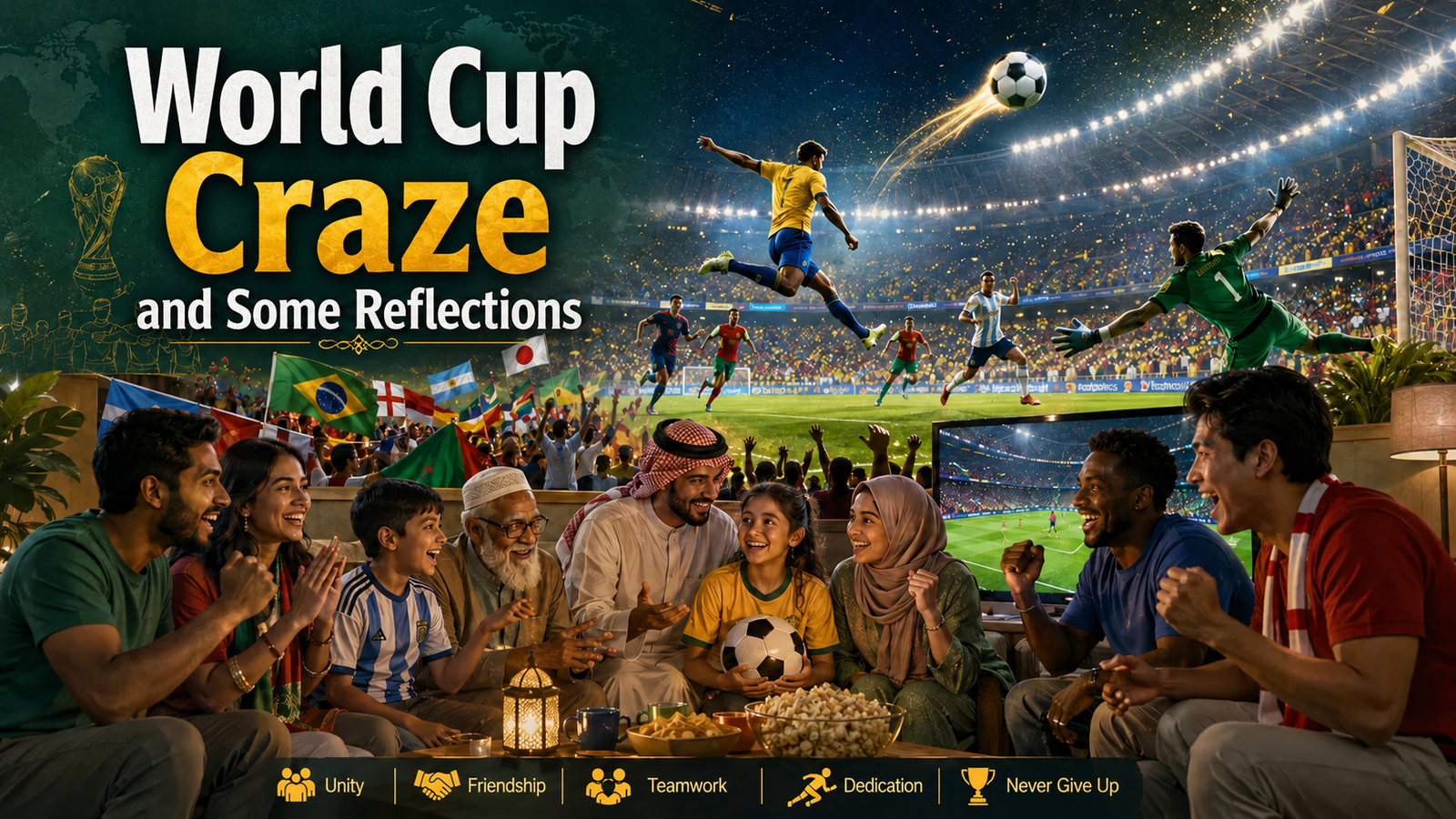
The FIFA World Cup is one of the largest sporting festivals on earth. For a few weeks, hundreds of millions of people transcend the boundaries of country, language, religion, and culture to share in the same excitement. Amid the pressures, fatigue, and monotony of everyday life, sport offers people a measure of relief. It brings families and friends together. The skill, discipline, teamwork, and determination of players to fight until the final moment can also be deeply inspiring.
There is therefore nothing wrong with watching the World Cup, cheering for a favourite team, or enjoying a beautiful goal. On the contrary, it is an international celebration in which people of different countries, races, languages, and cultures participate in a shared emotion. Although teams compete on the field, in the stands and public gatherings people encounter one another’s cultures, form friendships, and demonstrate humanity’s social capacity to experience joy together.
Yet the same event also brings some of our narrowness into the open. Insulting a player because of the colour of his skin, his religion, ethnicity, or nationality; hating a defeated team and its supporters; or dragging political hostility onto the football field reminds us that, despite enormous advances in technology and civilization, human society has still not freed itself from many ancient prejudices.
In this sense, the World Cup is more than a game. It is also a large mirror through which we can observe human beings and society. It reveals humanity’s capacity for unity, friendship, and joy, but at the same time exposes arrogance, racism, extreme nationalism, and intolerance.
The problem is not enjoyment. The problem begins when enjoyment turns into obsession or addiction, and sport starts consuming our time, attention, and sense of responsibility.
During the World Cup, a section of our society becomes so emotionally attached to foreign teams and players that one might imagine our own future depends on their victories and defeats. People lose sleep night after night, work and study are disrupted, and arguments on social media sometimes turn into personal hostility. In some cases, disputes over flags, teams, or players even lead to fights and clashes. At that point, love of sport is no longer healthy entertainment; it becomes a sign that we are losing control over our emotions.
There is also an uncomfortable contradiction here. We may know the number of goals scored by a player in a distant country, his club career, injuries, and even details of his personal history. Yet we often show far less interest in the condition of education, health care, unemployment, corruption, agriculture, the justice system, or the economy in our own country. The defeat of a foreign team can cause us genuine pain, while injustice in our own society, poverty, and the frustration of our young people may not move us nearly as much.
Some incidents in this World Cup have again demonstrated that football is no longer merely a competition on the field. Politics, state power, and the interests of influential individuals have also become intertwined with the game.
The controversy surrounding United States striker Folarin Balogun is a striking example. After receiving a straight red card against Bosnia and Herzegovina, he was expected under the rules to be suspended for the following match. U.S. President Donald Trump reportedly called FIFA President Gianni Infantino and asked him to review the decision. FIFA later upheld the red card but suspended the one-match ban for a one-year probationary period, allowing Balogun to play in the next match.
FIFA’s position was that its disciplinary committee made the decision independently and in accordance with its regulations. Yet the question remains: why should the head of state of a host country personally approach the FIFA president regarding the punishment of one of his country’s players? And why did such an exceptional decision follow that intervention?
For a similar offence, England’s Jarell Quansah received a two-match suspension, while Balogun’s punishment was suspended. Former FIFA referees questioned the logic and transparency of this different treatment, and UEFA also strongly criticised the decision. If the application of the rules appears to vary depending on the team, country, or political influence involved, both the fairness of the competition and FIFA’s neutrality are damaged.
The treatment of the Iranian team by host country the United States has also raised questions about equality. Iran’s players reportedly received visas to enter the United States only ten days before their first match. Some team officials and support staff did not receive visas at all. Because of the uncertainty, the team had to travel from Tijuana, Mexico, rather than operate from its originally designated base in the United States.
Initially, the Iranian team was reportedly instructed to enter the United States only one day before a match and leave the country on the same day the match ended. This forced the team to cross the border repeatedly from Mexico. Before the third match, the United States slightly relaxed the restrictions, allowing entry two days earlier, but the requirement to leave quickly after the match remained. The Iranian Football Federation complained that, compared with other teams, these arrangements reduced the team’s opportunities for preparation and rest. The United States, for its part, cited national-security concerns.
Security screening is a legitimate right of any state. But accepting responsibility for hosting the World Cup also means providing competitors from politically hostile countries with dignity, security, and, as far as reasonably possible, equal conditions for preparation. If equality is demanded on the field while one team faces unusual obstacles outside it, the World Cup’s message of unity and friendship is weakened.
The contrast is particularly striking. On one side, the president of the host country is personally speaking with the FIFA president in an effort to reduce the consequences faced by one of his own country’s players. On the other, players from a politically hostile country are subjected to stringent restrictions on entry, residence, and movement. When these two situations are placed side by side, it becomes difficult to deny the presence of power, politics, and inequality within the World Cup.
Racist and hateful behaviour during this World Cup has also caused concern. FIFA has reported a sharp increase in online abuse compared with previous tournaments. After the Netherlands lost to Morocco in a penalty shootout, several Black Dutch players who missed penalties became targets of racist attacks. The international players’ union FIFPRO has also argued that these are not isolated incidents, but symptoms of a growing and systemic problem in football.
A player may perform badly, miss a penalty, or make a poor decision. Such performances can certainly be criticised. But attacking someone because of skin colour, religion, or ethnicity has nothing to do with love of sport. It is an expression of social narrow-mindedness and moral decline. A World Cup that is supposed to bring people closer together reminds us, through such racist attacks, that alongside promoting harmony on the field, we also need to confront the prejudices within our minds.
There has also been controversy over mandatory hydration breaks introduced to protect players in extreme heat. Players’ health and safety must, of course, come first. But questions have been raised about whether scheduled breaks in each half interrupt the natural flow of football and whether they are gradually becoming commercial breaks for advertising. Critics argue that coaches are beginning to use them as tactical time-outs, altering the traditional rhythm of the game.
In modern football, the boundaries among player welfare, spectator enjoyment, and commercial interests are becoming increasingly blurred. The viewer may think he is simply watching a game. In reality, his time, attention, emotions, preferences, and consumption habits have all become part of an enormous global market.
This is also where newspapers and the wider media have an important role to play. Naturally, they want to publish subjects that attract contemporary public interest. Readership, online clicks, social-media sharing, advertising, and revenue are all interconnected. World Cup matches, predicted line-ups, players’ personal stories, statistics, forecasts, and post-match analysis easily attract vast audiences. There is therefore a clear commercial incentive behind this coverage.
But one fundamental question cannot be avoided: should the media merely follow the public’s existing interests, or should it also help make those interests more responsible and thoughtful?
The work of a good newspaper is not only to publish what people already want to read. It should also place before them what they need to think about. Sports news will certainly have its place. But if an important analytical article on education, health care, the economy, justice, culture, the environment, or weaknesses of the state cannot find space, while several reports, predictions, and reviews are published about the same match, questions about media priorities are inevitable.
It is often said that this is simply what readers want. That is partly true. But the media does not merely follow public taste; it also helps create it. Which subjects receive prominent headlines every day, which stories are repeatedly placed before readers, and which discussions are pushed into the background—all of these shape public interest. If serious and important subjects are presented in engaging language, they too can develop an audience.
A good piece of writing requires time, reading, research, and reflection. If such work is denied space simply because it may not generate as many immediate clicks, the loss is not only the writer’s. Society’s intellectual space also becomes narrower. Gradually, we may create a readership that responds instantly to excitement but is no longer accustomed to spending time thinking about deeper questions.
The solution, of course, is not opposition to sport. The World Cup will remain, and so will enjoyment, celebration, and analysis. But sport should not become a substitute for national thought. Alongside strong sports pages, we also need strong pages for ideas. Audiences should be offered not only excitement, but understanding. The media must maintain a balance between commercial realities and social responsibility.
A healthy nation enjoys sport, but does not lose itself in sport. It appreciates the beauty of a goal, while also questioning the politics, inequality, and commercial interests operating behind the game. It may fly the flag of a foreign team, but it does not lower the flag of its own country’s education, justice, and future.
The World Cup will end after a few weeks. The players will return to their countries and their own lives. What will remain with us are our society, our problems, and our future.
So we need enjoyment—but not self-forgetfulness; entertainment—but not at the cost of conscience, justice, and responsibility.